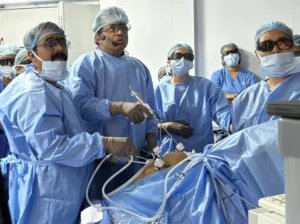
Surgical intervention for deep infiltrating endometriosis (DIE) is widely recognized as one of the most demanding subspecialties in modern gynecology. It is not a standard, routine keyhole operation. It is an intricate, highly artistic, and anatomically challenging procedure that requires a surgeon to possess deep expertise in pelvic retroperitoneal dissection. When a patient steps into our operating theater for deep endometriosis, they are undergoing a meticulously mapped out journey designed to eradicate the disease while fiercely protecting pelvic organ function.
To understand why specialized laparoscopic surgery is necessary, one must contrast it with standard gynecological techniques. For many years, laparoscopy for endometriosis relied on ‘ablation’ —using electrical current or heat to burn visible surface spots. While this technique works for superficial disease, it is completely ineffective for deep endometriosis. Burning a deep nodule is akin to cutting off the top of an iceberg; the active disease remains buried underneath, continuing to grow, secrete inflammatory chemicals, and invade nerves. Advanced surgery mandates laparoscopic *excision*. We use ultra-sharp dissection, combined with advanced energy sources like CO2 lasers or plasma energy, to cut out the diseased tissue completely, ensuring clean, disease-free surgical margins.
A critical phase of this advanced surgery is entering the retroperitoneal space. Deep endometriosis destroys the normal boundaries of the pelvis, often gluing the ovaries to the pelvic sidewall or pulling the ureters (the tubes carrying urine from kidneys to bladder) into dense nodules. A specialist must meticulously perform retroperitoneal dissection, identifying and separating major blood vessels, the ureters, and pelvic nerves away from the endometriosis lesions before any excision takes place. This process, known as ‘ureterolysis’ or pelvic mapping, ensures that the active disease can be safely excised without causing accidental injury to vital structural systems.
The visual clarity provided by modern technology has revolutionized this field. We utilize high-definition 4K and 3D laparoscopic camera systems that magnify the pelvic anatomy up to ten times. This intense magnification allows us to differentiate between normal, healthy tissue and the subtle, fibrotic alterations caused by deep endometriosis. We can clearly visualize tiny nerve pathways and subperitoneal tracks that would be completely invisible during standard surgery.
Recovery from such a precise and comprehensive surgery is remarkably rapid, thanks to the minimally invasive nature of laparoscopy. Because the procedure is performed through tiny 5mm to 10mm incisions, patients experience significantly less post-operative pain, minimal blood loss, a reduced risk of hernia or infection, and a much faster return to daily activities compared to traditional open surgery. However, the ultimate success of the operation depends entirely on the surgeon’s thoroughness. Complete laparoscopic clearance of deep endometriosis provides the single best chance for long-term symptom relief, a dramatic reduction in disease recurrence, and a profound restoration of physical well-being.