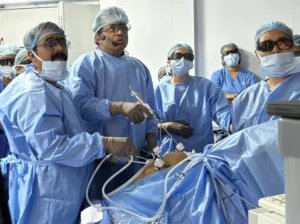
When deep infiltrating endometriosis involves the rectum, the surgical team faces a crucial decision: how to completely eradicate the active disease nodule while causing the absolute minimum disruption to the patient’s normal bowel function. In the past, any involvement of the bowel automatically triggered highly aggressive surgeries, such as removing large sections of the intestine. Today, with advanced laparoscopic mastery, we prioritize conservative, organ-sparing techniques. Among these, the ‘Laparoscopic Removal of a Rectal Nodule’ via specialized conservative methods stands out as a triumph of modern surgical precision.
Conservative removal of a rectal nodule is indicated when the endometriosis lesion involves the outer muscular layers of the rectum but has not extensively encircled the bowel wall or caused a severe internal blockage. The two primary conservative techniques we utilize are ‘Rectal Shaving’ and ‘Laparoscopic Disc Excision.’ Both methods are designed to completely remove the endometriosis while leaving the core continuity of the intestinal tube fully intact, avoiding the need for complex bowel reconstructions.
The first technique, Rectal Shaving, is an elegant procedure reserved for nodules that are superficial or moderately deep within the bowel wall muscle. During a rectal shave, the surgeon enters the rectovaginal space and utilizes ultra-precise keyhole instruments to carefully slice, or ‘peel,’ the hard fibrotic nodule off the healthy underlying muscular layers of the rectum. It is highly analogous to peeling the skin off an apple. The surgeon peels until healthy, soft, pink rectal muscle fibers are clearly visible. Because the internal chamber of the bowel is never opened, the risk of contamination or major leaks is virtually zero, and recovery is exceptionally fast.
The second technique is Laparoscopic Disc Excision, which is utilized when the rectal nodule penetrates deeply through the muscular wall but remains localized to a small, distinct area (less than 2 to 3 centimeters in size). In this procedure, the surgeon cuts out a full-thickness ‘disc’ or circular piece of the rectal wall that contains the entire nodule. Once the diseased disc is removed, the resulting opening in the rectum is immediately closed, typically using an advanced circular surgical stapling device or via hand-sewn laparoscopic suturing. This allows for complete eradication of deep-seated disease while preserving the overall length and capacity of the rectum.
The benefits of these conservative, organ-sparing approaches are profound. By avoiding a full segmental bowel resection, we drastically minimize the risk of serious complications, such as anastomotic leaks or long-term alterations in bowel habits (such as chronic urgency or frequent bowel movements). Furthermore, these techniques significantly lower the need for a temporary stoma bag. Patients can expect an excellent postoperative recovery, rapid return to regular diet, and complete relief from the agonizing cyclical bowel pain that previously dictated their lives. Choosing a specialist who is well-versed in the entire spectrum of bowel endometriosis surgery ensures that your treatment is as conservative as safely possible, protecting both your pelvic peace and your intestinal health.