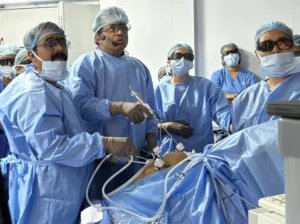
For a woman diagnosed with endometriosis who dreams of building a family, the choice of surgical technique is of paramount importance. Surgery for endometriosis in a patient wishing to preserve or enhance her fertility cannot be approached casually; it requires a deeply conservative, protective philosophy. Every single movement of the surgeon’s hands must be guided by a single mandate: eradicate the painful disease while fiercely protecting and preserving the precious, irreplaceable ovarian reserve and delicate reproductive organs.
Fertility-enhancing laparoscopic surgery is a highly specialized approach that blends radical disease clearance with organ preservation. The primary goal is to restore the normal anatomical relationships within the pelvis. Endometriosis frequently glues the ovaries behind the uterus, traps the fallopian tubes in dense scar tissue, and tilts the womb out of place. By carefully releasing these adhesions and clearing out active lesions, we restore the ‘pelvic pickup mechanism’ —ensuring that the fallopian tubes are free to move, capture an egg during ovulation, and safely transport it for fertilization.
The management of ovarian chocolate cysts (endometriomas) during fertility surgery requires absolute surgical mastery. A standard, aggressive approach can destroy thousands of healthy, pristine eggs surrounding the cyst wall. To prevent this, we utilize a highly meticulous ‘stripping technique.’ Instead of roughly tearing the cyst away or burning it blindly, we identify the exact micro-plane of tissue separating the cyst wall from the healthy ovary. Using gentle hydro-dissection (injecting fluid to separate layers) and dual-traction, we gently peel the cyst wall out, minimizing any trauma to the remaining healthy ovarian follicles.
Another critical aspect of fertility-preserving surgery is the strict limitation of thermal energy (electrosurgery). Excessive heat from standard bipolar instruments can travel through the ovary, cooking and destroying the delicate eggs. In our practice, we minimize the use of heavy cautery. To control bleeding inside the ovary after removing a cyst, we prefer to use microscopic, delicate suturing with ultra-fine threads or modern biological hemostatic agents. This protects the vascular blood supply to the ovary without exposing the delicate tissue to damaging heat, ensuring that post-operative Anti-Müllerian Hormone (AMH) levels remain optimized.
At the conclusion of every fertility-enhancing operation, we routinely perform chromopertubation—a tubal flushing test where a blue dye is gently injected through the cervix to visually confirm under laparoscopic view that the fallopian tubes are wide open and functional. We also apply advanced anti-adhesion barriers (specialized gels or sheets) over the surgical sites to prevent new scar tissue from forming during the healing phase. By combining extreme surgical gentleness with advanced structural restoration, fertility-enhancing laparoscopy bridges the gap between pain relief and the successful realization of motherhood.